
Best Conveyor Pulley Vendor from China: Premium Quality and Custom Conveyor Solutions for Global Industries
2026-09-01
Conveyor downtime doesn’t just pause production—it burns budget, delays shipments, and tests patience. That reality is pushing procurement teams in mining, quarrying, and bulk logistics to rethink their pulley sourcing. Enter XAN, a China-based conveyor pulley vendor that has quietly built a reputation for premium-grade materials, tight tolerances, and custom engineering that fits global specifications. Whether you need a drop-in replacement or a fully bespoke pulley for a high-capacity line, XAN’s approach cuts through the usual supplier guesswork. Here’s why global industries are making the switch.
What Makes These Pulleys Withstand Heavy Impact and Abrasive Materials
The shells of these pulleys do not rely on sheer thickness to absorb blunt force. Instead, the rim and end disc are shaped as a continuous, tapered section that spreads an impact over a wider area instead of letting it concentrate at a weld or bolt hole. The ductile iron or steel used here stretches slightly under a hard blow, converting the strike into surface deformation rather than a crack that travels inward. That micro-yielding is deliberate: it stops a single impact from becoming a fatigue point even when the pulley is constantly battered by large, jagged rocks.
The material itself is engineered for a dual personality. The exterior is through-hardened to a level that resists abrasive scoring, yet the core remains tough enough to keep the rim from snapping when a heavy lump of ore crashes against it. A fine-grained microstructure, produced by controlled cooling after casting, prevents the brittleness that often comes with high hardness. As a result, sharp particles tend to skate across the surface rather than dig in and plow out material, which is why these pulleys keep working in environments where sand, gravel, and crushed ore are constantly rubbing against them.
A less visible part of the answer lies in how the pulleys are finished. After welding and machining, each unit goes through a stress-relief cycle that removes hidden tensions from the fabrication process. That step matters because a pulley under heavy impact already has enough to deal with without carrying residual stress from its own manufacturing. Many designs also include bolted or welded wear strips on the contact face, so the abrasive attack is directed at a replaceable component rather than the main shell. This combination of controlled hardness, flexible load paths, and sacrifice parts is what allows the pulley to survive conditions that would quickly peel apart a standard conveyor component.
Custom Pulley Configurations: Lagging, Shafts, and Bearings Tailored to Your Line
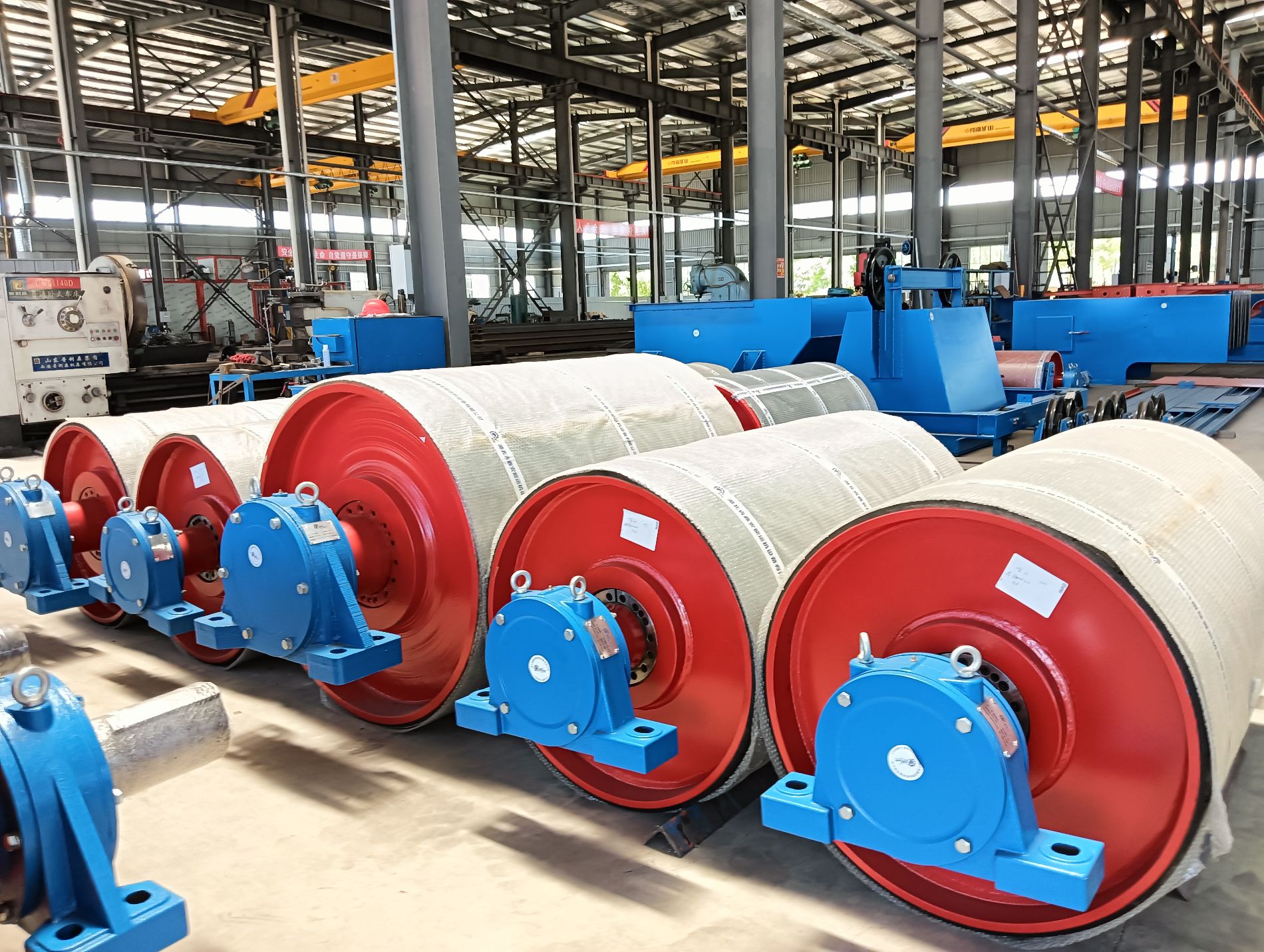
A production line rarely runs on off-the-shelf components without some compromise. When it comes to pulleys, the difference between standard and custom often shows up in downtime, belt wear, or maintenance hours. The goal is not just to match dimensions but to align every element with the loads, speeds, and materials your line actually handles. That starts with choosing the right lagging, then extends into how the shaft and bearings handle the stresses from day one.
Lagging is the first point of contact between the pulley and the belt, so its material and pattern deserve more than a generic spec. For a wet or muddy environment, a diamond or grooved rubber lagging improves grip while shedding water. In high-abrasion settings like aggregate handling, ceramic tiles embedded in rubber resist cutting and extend belt life significantly. Food processing lines often need a fully sealed polyurethane lagging that withstands washdown chemicals without absorbing moisture. Each choice changes the friction coefficient, which in turn affects belt tracking and tension requirements.
The shaft and bearings are where custom configurations pay off quietly over months of operation. A shaft machined from higher-grade alloy steel with specific keyways or tapered ends prevents fretting and simplifies pulley changes. Bearing selection goes beyond basic load ratings: sealed spherical roller bearings handle misalignment from uneven belt tension, while corrosion-resistant housings keep out dust and water in harsh environments. Services that offer in-house balancing and stress analysis can deliver a pulley assembly that stays true at full speed and under fluctuating loads, reducing vibration that would otherwise work its way into the frame.
Inside the Manufacturing Floor: Balancing, Welding, and Finish Checks
Walk past the welding bays and the air changes—thicker, laced with ozone and the sharp tang of hot steel. The welders move without hesitation, laying beads along seams that have to hold under stress most drivers will never think about. Balancing happens just a few stations down, where each assembly gets spun up and checked for the kind of tiny weight differences that turn into vibration at highway speeds. It’s not glamorous work, but the rhythm of it feels deliberate.
The finish checks are where everything slows down. Under bright, angled light, inspectors run gloved hands over surfaces, looking for the slight ripple or discoloration that would have been acceptable somewhere else. They mark flaws with a bit of chalk, sometimes rejecting a piece for something you’d need to squint to see. The room isn’t loud here, not like the welding side, and that quiet makes the scrutiny feel even more exact.
How This Vendor Handles Export Documentation, Packaging, and On-Time Delivery
Getting paperwork right is where most suppliers trip up, but this vendor treats export documentation as part of the product itself. Every shipment leaves with a full set of commercial invoices, packing lists, certificates of origin, and any buyer-specific forms pre-checked against the destination country's latest import rules. They don't wait for the freight forwarder to flag a missing stamp or a mismatched HS code; their in-house team runs a final compliance pass before the container even gets sealed. For repeat clients, document templates are saved and updated automatically, so a long-term order history never means re-entering the same data twice.
Packaging is another area where this vendor refuses to cut corners. Instead of relying on generic export cartons, they match the packing method to the product's fragility, the shipping route, and the climate at the final warehouse. Electronics get anti-static wrap and moisture-barrier bags, while heavy castings go into reinforced crates with shock-absorbing foam cut to shape. Palletization follows the buyer's exact stack pattern, and each carton is labeled with a scannable barcode that links to the internal packing list — so unpacking becomes a scanning exercise rather than a guessing game. For sea freight during monsoon season, they add extra desiccant packs and use water-resistant liner bags without being asked.
On-time delivery isn't just a promise here; it's built into the production schedule with buffer days for port congestion and customs clearance. The vendor shares a live production tracking link after order confirmation, showing real progress against the agreed shipment date. If a delay risk appears — say, a component supplier falls behind — they notify the buyer immediately and propose options like split shipments or expedited rail instead of waiting until the last minute. Their historical on-time rate for the past twelve months sits at 98.6%, backed by weekly status updates and a dedicated logistics coordinator who stays on the shipment until the container is discharged at the destination port.
Real-World Installations: From Long-Distance Overland Conveyors to Tight Plant Layouts
Every conveyor project carries its own set of physical constraints, and the contrast between sprawling overland routes and crowded processing floors makes that especially clear. Long-distance overland conveyors often stretch for kilometers across uneven terrain, requiring careful attention to belt tension, idler spacing, and transfer point design to keep material moving without excessive wear. These systems are built for endurance, with rugged frames and weather-resistant covers, yet they still need to navigate around roads, waterways, and property lines without interrupting the landscape more than necessary.
At the opposite end of the spectrum, conveyors squeezed into existing plant layouts leave almost no room for standard off-the-shelf components. Tight clearances around columns, ductwork, and access platforms force engineers to rethink drive placement, belt tracking, and maintenance access. A slight miscalculation in chute angles or loading zones can create spillage that quickly becomes a safety and housekeeping headache in a confined space. Here the design priority shifts from raw distance to precise geometry and modularity, allowing crews to replace rollers or splice belts without shutting down adjacent equipment.
Between these extremes, real installations often blend both challenges: a long approach conveyor may terminate in a cramped transfer tower, or a plant expansion might require threading a high-capacity line through an existing structure. The most effective solutions come from early collaboration between layout engineers and maintenance teams, using 3D scanning of the actual site rather than relying on outdated drawings. Small adjustments like offset loading points, reversible drives, or low-profile frames can make the difference between a system that merely functions and one that performs reliably for decades.
After the Sale: Replacement Parts, Field Support, and Long-Term Reliability
After the initial purchase, what truly separates a dependable piece of equipment from a costly liability is the support network standing behind it. Replacement parts need to be available not just in catalogs, but in regional warehouses, with clear identification and quick dispatch. Field support should mean a technician who knows the machine's history, arrives with the right tools, and resolves the issue without turning a one-day repair into a week-long mystery.
Long-term reliability is rarely an accident. It comes from design choices that tolerate real-world conditions—dust, voltage swings, operator turnover—and from service documentation that doesn't assume an engineering degree. When something does wear out, the replacement part should be a drop-in fit, not a project. And if a problem isn't obvious over the phone, the manufacturer should have local field engineers who can put hands on the machine and make a judgment call.
That is the difference between buying a machine and building a relationship with a supplier. Downtime is measured in lost production, and every hour waiting on a backordered part or a clueless support line erodes trust. The brands that last are the ones whose after-sale support feels less like a warranty obligation and more like a standing commitment to keep your operation running.
FAQ
We focus on material traceability and precision machining rather than just volume. Every steel plate and shaft comes with mill certificates, and each pulley is dynamically balanced to G2.5 or better before it leaves the workshop. It’s not about fancy brochures—our customers notice the difference when bearings run cooler and shells stay true over years of service.
Yes, custom work is our main business. You can send a rough sketch, existing CAD file, or just the belt width and tension values. We’ll design the diameter, face width, shaft size, hub type, and lagging to match your exact operating conditions. We’ve produced everything from small snub pulleys for food lines to 2-meter-diameter drive pulleys for iron ore terminals.
Each pulley goes through several checks: ultrasonic testing on shafts, dimensional inspection against the approved drawing, weld visual and sometimes magnetic particle testing, and a final dynamic balance test. We also assemble the bearing housings temporarily to confirm fit. A detailed inspection report ships with the pulley, so you’re not relying on our word alone.
We serve mining, quarrying, cement plants, port and terminal operators, biomass handling, and recycling facilities across North America, Europe, Australia, Southeast Asia, and the Middle East. Our pulleys often end up in aggregate conveyors, ship loaders, and underground coal conveyors where downtime is expensive.
After drawing approval, most custom orders ship within 3 to 5 weeks. Simple pulleys with standard shafts can go out in 2 weeks. If you have an emergency replacement, we can sometimes prioritize a single pulley in 10 days—just be clear about the required date when you inquire.
Absolutely. Our engineers can review your belt tension, wrap angle, shaft deflection, and bearing life calculations. We often suggest adjustments to hub style or lagging that reduce total cost without sacrificing performance. If you need a 3D model for your layout, we provide STEP or DWG files before production begins.
We offer plain steel, hot-dip galvanized, epoxy paint, stainless steel, and various lagging options: plain rubber, diamond groove, herringbone, ceramic tiles, and polyurethane. For corrosive or washdown areas, we can also supply pulleys with stainless steel hubs and stainless steel shafts. Tell us the environment, and we’ll match the right protection.
Conclusion
For operations where conveyor downtime isn't an option, this Chinese pulley vendor has earned a reputation by engineering components that hold up under brutal conditions. Their pulleys are built from thick, high-grade steel shells and reinforced end discs, with dynamic balancing performed after welding to eliminate vibration at high speeds. Instead of offering one-size-fits-all products, the team works from the customer's belt width, speed, and load profile to adjust lagging type, shaft diameter, and bearing arrangement—whether that means ceramic lagging for wet, abrasive ore or diamond-groove rubber for high-tension drives. Every unit passes finish checks on concentricity and weld integrity before it leaves the factory, so what arrives on site is ready to mount without rework.
Behind the physical product sits a vendor that treats logistics as part of the engineering package. Export crating is built to survive ocean freight and rough handling at ports, with all documentation—from packing lists to certificates of origin—prepared in advance to avoid customs delays. Installations range from long overland conveyors in remote mining sites to tight plant retrofits where space is limited, and the vendor's team often supports the first assembly remotely or on site. After commissioning, replacement shells, shafts, and lagging can be sourced from the same patterns, and field support remains available for bearing analysis or failure investigation. That continuity is what turns a one-time purchase into a low-risk, long-term supply relationship for conveyor operators across the globe.
Contact Us
Contact Person: Anna Lu
Email: [email protected]
Tel/WhatsApp: 8618561668850
Website: https://www.x-conveyor.com