Best Eyelash Brush Manufacturer Delivering Salon-Quality Results
2026-10-08
Finding an eyelash brush that actually delivers salon-quality results shouldn’t feel like a gamble. Too many manufacturers cut corners, leaving you with uneven bristles and flimsy handles. KLDZS takes a different approach—every brush is built to the exacting standards professional lash artists rely on. Whether you’re outfitting a studio or launching your own line, the right manufacturing partner makes all the difference. Here’s what sets KLDZS apart.
What Your Current Eyelash Brush Gets Wrong About Root-to-Tip Coating
Most eyelash brushes are designed to grab a lot of product, but they struggle to place it precisely at the lash root. The bristles often pack together too tightly, so when you pull the wand through, mascara gets pushed ahead of the bristles and lands in a thick clump near the tips. The base of the lashes is left with barely any coating, which means you lose definition exactly where the lash line should look fullest.
Another common flaw is that the brush doesn't follow the natural curve of your lash line. If the wand is too straight or too fat, you end up skimming over the root zone and depositing most of the formula on the middle and tip sections. This can make lashes look heavy at the ends and sparse at the base—almost as if they're floating instead of anchored to your lid.
A better brush tapers toward the tip and mixes shorter and longer bristles so it can coat the root first, then comb through to the ends without overloading them. That root-to-tip distribution is what gives lashes lift and a natural density. If your current wand leaves the roots bare and the tips clumpy, it's rarely your technique—it's the brush working against you.
The Injection Mold Detail Behind That Salon-Level Lash Fan
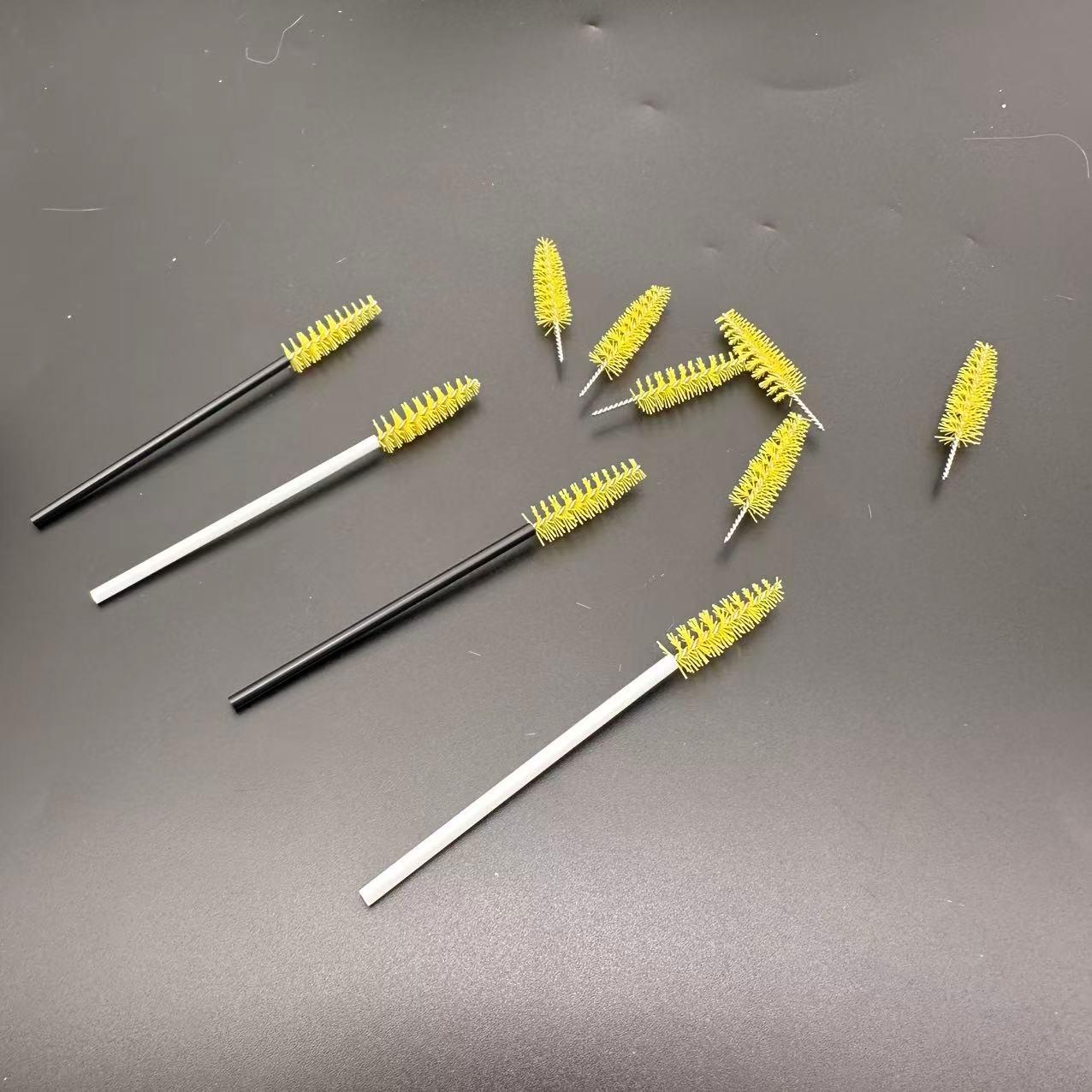
Most cheap volume fans get their shape from crude multi-cavity molds that leave a visible seam right where the lashes meet the base. The salon-level version starts with the gate location. Instead of injecting at the thickest section, the mold feeds from a sub-gate near the tip side, which shifts the weld line away from the stress point and lets the resin fill each 0.07 mm micro-fiber without freezing off early.
The cavity polish does more than add shine. On a lash fan, a mirror finish along the base radius prevents the tiny plastic “hooks” that make fans tangle when you pick them up with tweezers. It also keeps the ejection pins from leaving drag marks across the outer curve. Some molds run a textured micro-rib down the back of the base, not for decoration, but to break surface tension so the adhesive bond wets evenly instead of beading.
Then there’s the shut-off angle on the fiber channels. If it’s even half a degree too steep, the mold opens with micro tears at the tip. Salon-level tooling uses a tapered shut-off combined with a short cold slug well, so the tips come out crisp without brittle flash. That’s the difference you feel when a fan spreads with one tap instead of collapsing into a clump.
Why Bristle Memory Matters More Than Bristle Count
Bristle count gets all the marketing hype, but it's the memory of those bristles that quietly decides how a brush actually behaves after a few weeks of real use. A dense head with poor memory ends up splaying, tangling, or turning into a flat, lifeless mat long before the bristles themselves wear down. High-memory filaments, by contrast, snap back to their original alignment after every stroke, resisting deformation even when they're wet, loaded with product, or crammed into a travel bag.
This resilience matters because it preserves the geometry of the brush. If the tips don't return to their intended position, you lose the precise contact patch that gives you control over blending, buffing, or lining. Over time, a brush with strong memory feels nearly identical to the day you bought it, while a count-heavy brush can become a completely different tool in a month. That consistency reduces wrist fatigue and guesswork, since you're not constantly compensating for a shape that keeps changing.
In the end, bristle count is just a number on a label. Bristle memory is a physical property you can feel every time the brush touches a surface. When you stop chasing maximum density and start paying attention to how filaments recover, you'll pick brushes that stay useful for years instead of ones that look impressive in a close-up photo and disappoint in daily practice.
A Handle Curve That Reads Your Wrist Before You Do
The curve doesn't wait for you to find the right grip. It settles into the hollow of your palm and follows the natural line of your wrist before you even think about adjusting. There's no awkward break-in period, no moment of shifting your hand back and forth to get comfortable.
That gentle sweep under the heel of your hand does most of the work. Instead of forcing your wrist into a single angle, the handle gives way just enough to let your forearm and fingers stay relaxed. You notice it most when you've been holding on for a while and your wrist still feels loose, not locked into place.
Most handles make your hand adapt. This one reads the small movements you make before you make them, so the support is already there when you lean into a turn or change direction. It's less about cushioning and more about anticipation.
Materials That Stay Soft After Repeated Sterilization
Most medical-grade silicones hold their durometer well, but repeated autoclave cycles eventually stiffen the polymer chains unless the formulation includes stabilizers that slow oxidative crosslinking. The difference shows up in the details: a well-chosen silicone returns to its original pliability after fifty cycles, while a cheaper blend starts to feel boardy around cycle twenty.
Thermoplastic elastomers can be more temperamental. Some TPEs tolerate steam, but many lose plasticizer or undergo chain scission, leaving the surface tacky then brittle. For parts that need to stay soft, peroxide-cured silicone or select polyurethane blends are often preferred because their flexibility comes from the backbone rather than from additives that migrate out.
It’s worth checking the supplier’s data for compression set and Shore A before and after cycling. A small change in Shore A may not look alarming on paper, but hands-on testing tells you more—if a gasket no longer conforms to the mating surface or a grip feels harder than the first day, the material has already drifted past what users will accept.
Customization That Doesn't Rewrite Your Production Timeline
Most suppliers treat customization as a special request that inevitably adds weeks to your lead time. We built our production system differently. Our modular component library and flexible assembly stations let us swap materials, dimensions, and finishes without re-sequencing the entire line. Custom orders flow through the same schedule as standard ones because the change happens at the configuration stage, not on the factory floor.
The key is our parameter-driven design tool. When you adjust a spec, the system automatically checks it against real-time inventory and machine capacity, then locks the bill of materials before production begins. There's no back-and-forth with engineers, no waiting for revised drawings, and no surprises halfway through. Any customization that passes the automated feasibility check is treated as a standard work order from that moment on.
As a result, you get a product tailored to your requirements without paying the usual time penalty. In many cases, our customized orders ship in the same window as off-the-shelf items—sometimes even faster, because we plan customization batches to fill idle capacity. That means your production timeline stays intact, no matter how unique your specifications are.
FAQ
Salon-quality starts with bristle precision. We taper each synthetic fiber to a fine point so it coats lashes evenly without clumping. The handle also matters - ours are weighted to reduce hand fatigue during back-to-back appointments.
We don't rely on spot checks alone. Every batch goes through a three-stage inspection: bristle alignment, ferrule crimping, and handle finish. We also run a small-batch pilot before full production to lock in specs.
Yes, we offer full customization. You can choose handle colors from a Pantone-matched palette, add your logo via laser engraving or pad printing, and even adjust the brush head curve. We send a physical sample within five days.
We use a blend of PBT and nylon for bristles, which holds its shape after repeated cleaning. Handles come in FSC-certified wood, recycled aluminum, or bio-resin. All materials are tested for skin contact safety.
Our production line is split into modular cells, so we can run multiple customizations in parallel. For orders over 50,000 units, we typically ship within 20 days. A dedicated account manager updates you weekly.
We specialize only in eyelash brushes, so our tooling is refined for lash application specifically. For example, our ferrule has a micro-groove that prevents bristle shedding even after hundreds of uses.
Absolutely. We offer a starter tier of 500 units per design, and our design team helps you choose the right brush shape for your lash serum or mascara formula. We also provide unbranded stock options for faster launch.
Conclusion
Most eyelash brushes fall short before the formula even touches the lash line. The bristles either grab too much product at the base or leave the tips dry, which means you're constantly dipping back into the tube and fighting clumps. What sets a true salon-grade tool apart is how the brush is built from the start—not just the bristle count, but the way those bristles spring back after every stroke. A well-designed injection mold creates a fan that opens evenly at the root, while a handle curve that matches the natural angle of your wrist reduces the micro-adjustments that lead to smudging. It's the kind of detail you feel on the first pass: the brush lifts, separates, and coats without dragging.
Beyond the initial application, durability is where many brushes quietly fail. Materials that turn stiff after repeated sterilization or lose their shape after a few washes force artists to replace tools too often. A manufacturer focused on salon-quality results uses polymers that keep their softness and memory through countless cleaning cycles. Customization also shouldn't mean waiting months for a redesign. Small changes in ferrule length, bristle density, or handle texture can be integrated without stalling your production schedule. That balance—performance that holds up and flexibility that doesn't slow you down—is what separates a reliable factory from one that truly understands the rhythm of a working salon.
Contact Us
Contact Person: Caiju Zhang
Email: [email protected]
Tel/WhatsApp: +86 14763963294
Website: https://www.kldbrush.com