
China Pizza Box Innovations Transforming Global Food Packaging
2026-11-16
Pizza boxes have long been an afterthought in the global food industry—sturdy, functional, and utterly forgettable. But that’s changing fast, and the source of this shift might surprise you: China. As one of the world’s largest pizza consumers, the country has turned packaging into a competitive art, blending engineering smarts with sheer scale. Now, these innovations are crossing borders, redefining how restaurants worldwide think about heat retention, grease resistance, and even sustainability. At the forefront of this quiet revolution is Zemeijia, a manufacturer that has moved beyond simply making boxes to pioneering designs that challenge old assumptions about cost and performance. Prepare to see the humble pizza box in a whole new light.
Rethinking the Slice: How Chinese Design Is Reshaping Pizza Delivery
In China, the humble pizza box has evolved into a multi-functional canvas. Designers are reengineering the entire unboxing ritual with built-in perforated plates, cutlery drawers formed from recycled pulp, and grease-resistant surfaces that eliminate the need for separate liners. One Guangzhou startup even introduced a heat-retaining stand integrated into the lid, turning the box into a makeshift serving tray for small apartments where table space is scarce.
Beyond structural tweaks, visual storytelling is redrawing the slice itself. Illustrators weave regional food narratives onto packaging, replacing standard pizza imagery with ink-wash Sichuan peppers or plump soup dumplings — a deliberate nudge that pizza, in the Chinese context, deserves its own iconography. This cultural remix extends to typography, where calligraphic brushstrokes meet menus, subtly anchoring a foreign product in local everyday life.
Perhaps the most radical departure comes from material science. A wave of biodegradable boxes now leverages tea waste and mushroom mycelium, tackling China’s colossal delivery waste. Some explore edible rice-paper compartments for dipping sauces, literally dissolving the boundary between packaging and food. These innovations aren’t just eco-responses — they’re part of a broader philosophy treating the box not as disposables, but as an extension of the dining experience from the first touch to the last bite.
Ventilated Vistas: Moisture Control That Keeps Crusts Crisp
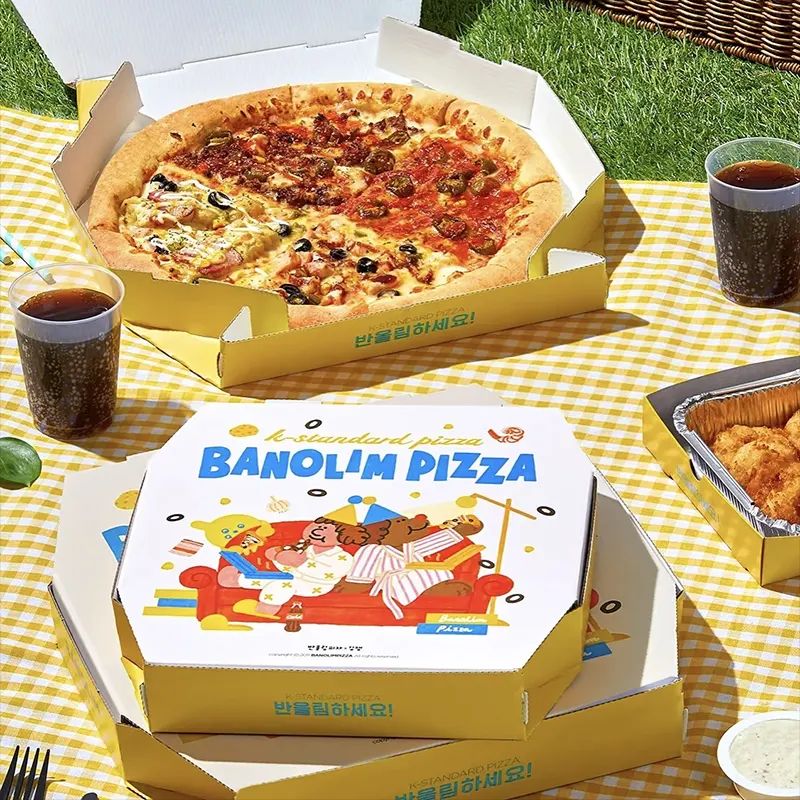
A crackling crust isn't just about the initial bake—it's a delicate balance between trapped steam and gradual release. The moment food leaves the oven, residual heat continues pushing moisture outward. Without a well-designed escape route, that vapor condenses right at the surface, turning what should be a shatteringly crisp exterior into something disappointingly soft. Think of a perfectly roasted potato or a freshly fried cutlet: the difference lies in how air moves around it, carrying away humidity before it settles.
Many home cooks focus solely on temperature, but airflow is the quiet partner in texture. A rack that elevates food isn't just for even heating; it creates micro-channels where circulating air wicks away escaping steam. In professional kitchens, perforated pans and wire grids serve the same purpose—they prevent that soggy underside that comes from sitting in a pool of its own moisture. Even small adjustments, like propping open an oven door a crack during the last few minutes, can transform the final crunch by letting humid air escape rather than reabsorbing into the crust.
Moisture control continues long after cooking stops. Stacking hot, crisp items in a sealed container is a surefire way to steam everything soft. Instead, leaving containers slightly vented or using materials that don't trap condensation—like paper bags or breathable wraps—maintains that just-cooked texture. It's about respecting the food's ongoing relationship with its environment: a vista of moving air that guards the crispness you worked so hard to achieve.
Built-in Plate Tech: The Fold-Flat Feature Taking Over
Fold-flat plates are the quiet revolution happening right under our dinnerware. Instead of applying a flimsy, removable tray that gets lost in the drawer, today’s smartest camping and compact-living gear embeds the collapsing mechanism directly into the plate itself. Press the center section, hear that satisfying click, and the rigid rim transforms into a shallow bowl or collapses into a flat disc no thicker than a stack of coins. It’s a design trick borrowed from aerospace hinges and living-hinge polymers, but one that feels almost magical when you’re washing up in a tiny campervan sink and realize this single piece does the work of three.
What separates a gimmicky collapse from genuine built-in plate tech is material memory. The best versions use a durable, food-safe silicone that’s bonded to a rigid core or a precision-scored polypropylene that bends only along predetermined flex lines, retaining its shape after hundreds of meals. You’re not babying it; you’re throwing it into a backpack, snapping it open for a charcuterie spread, then folding it back down to slip behind a cutting board. No separate origami instruction, no pinched fingers—the fold lives entirely within the object’s architecture.
This approach is quietly dismantling the old trade-off between packability and stability. Because the hinge is part of the plate, flat surfaces stay perfectly flat when deployed, no wobble, no rim that slowly warps. It’s why lightweight kitchen lines are moving away from nesting sets and toward a single, stellar plate that rides in your daypack yet holds a full pasta serving without flexing. Fold-flat tech isn’t about saving space for the sake of minimalism; it’s about letting a plate behave like a tool, one that adapts to the moment and disappears when the meal ends.
From Bamboo Pulp to Bagasse: Materials Driving the Green Shift
Not long ago, bamboo pulp seemed destined for niche markets—reusable cutlery, specialty papers, a few eco-conscious textile lines. Its rapid growth cycle and minimal need for pesticides made it a poster child for renewable sourcing, but the material rarely broke into mainstream manufacturing. That’s shifting now. Engineers have learned to process bamboo fibers into packaging sturdy enough to replace molded plastic, and designers are pushing it into everything from phone cases to car interiors. The real surprise is how quietly the transition happened: supply chains adjusted, pulping methods grew more efficient, and suddenly a grass once associated with handicrafts became an industrial staple.
Bagasse followed a similar arc but from an entirely different origin—the mountains of fibrous leftovers from sugarcane processing. For decades, mills burned it as low-grade fuel or let it rot, treating it as a disposal problem. Today, the same material gets pressed into clamshell containers, plates, and bowls that hold hot soup without buckling. Why bagasse sticks is not just its heat tolerance but its story: a waste stream turned into a high-functioning product right at the point of harvest. There’s something elegantly circular about a sugar crop yielding not only sweetener but also the tray that carries your takeaway meal. And because the raw material already sits at the processing plant, the carbon math works better than many purpose-grown alternatives.
Neither bamboo pulp nor bagasse alone will displace petroleum-based materials, but together they signal a broader change in how we read the label. The materials gaining ground share an unromantic practicality—they exploit what’s already abundant, fast-growing, or unavoidably generated. Coconut husks, hemp shiv, mycelium networks: each follows the pattern. What sets bamboo and bagasse apart is that they’ve already moved past the laboratory and the pilot project. They show up on shelves without fanfare, which is perhaps the truest sign that the green shift is no longer an experiment. It’s just the next batch of inventory.
Smart Stacking and Space-Saving Geometry in Transit
The art of fitting irregular shapes into a confined transit space relies heavily on geometric pairing—matching convex protrusions with concave recesses so that components nest like puzzle pieces. By rotating certain items just a few degrees, you can often slash the dead air between loads by twenty percent or more, turning what looked like a full container into one with room to spare.
Tetrahedral and hexagonal designs are slowly replacing the default rectangular box in high-density freight. These profiles allow load-bearing contact along multiple axes, distributing impact during transport while eliminating the need for excessive dunnage. The result is a self-stabilizing stack where each unit locks into its neighbours, and the load becomes its own shock absorber.
Smart stacking algorithms now map out the ideal arrangement before a single item leaves the warehouse floor, using real-world centre-of-gravity data rather than simplistic bounding boxes. Coupled with modular containers that expand and contract like honeycomb lattices, logistics chains are achieving fill rates that were unthinkable a decade ago—all from rethinking the geometry behind every cubic inch.
Cultural Codes on Cardboard: Branding Beyond the Logo
A logo might catch the eye, but cardboard packaging speaks in a quieter, more persistent voice. It carries the weight of cultural memory through its texture, its folds, even the soft sound it makes when opened. An unbleached kraft surface can suggest honesty and handmade tradition, while a sleek, clay-coated box might whisper of precision and luxury. These material choices are not random; they tap into deeply rooted associations that shape how we feel about a brand before we even read a single word.
Color becomes a subtle storyteller on this humble stage. A matte olive green can evoke notions of sustainability and natural wisdom, while a strip of vibrant red along a tear line might channel energy, urgency, or luck depending on where the package finds its home. Typography, too, plays a cultural code-breaker: an elegant serif printed directly onto recycled board can bridge the gap between timeless craftsmanship and modern eco-conscious values, creating a tension that feels far more authentic than a polished corporate slogan.
The true magic happens when a brand understands that an unboxing ritual is a form of non-verbal conversation. A perfectly weighted inner sleeve, a hidden message visible only as you extract the product, the deliberate absence of plastic—these elements don't just protect the contents, they articulate a worldview. In an age of digital noise, this tangible, slow-released set of cultural signals often builds trust more effectively than any ad campaign, transforming a simple container into a story you can hold in your hands.
FAQ
They're integrating smart materials and foldable origami-inspired structures that keep pizza crisp for hours. Some even embed heating elements or plant-based insulation to replace traditional corrugated cardboard.
Many new designs use agricultural waste like wheat straw or sugarcane bagasse, which decomposes within weeks. Others have edible coatings that eliminate the need for plastic liners, tackling both grease resistance and landfill waste.
Absolutely. Steam-release vents and humidity-control layers prevent sogginess, while some models include a perforated raised platform that keeps the crust elevated. You end up with a pie that tastes much closer to fresh-out-of-the-oven quality.
Several major chains in Europe and Southeast Asia have started pilot programs. They're drawn by the lower shipping costs of flat-pack designs and the marketing appeal of fully compostable boxes that customers can simply bury in their gardens.
Some versions now include temperature-sensitive ink that shows whether the pizza is still warm, or QR codes that lead to games and AR experiences. One design even transforms into a tabletop game once the pizza is gone.
Through a lotus-leaf-inspired micro-texture that naturally repels oil, or by blending bamboo fibers with plant-based waxes. This eliminates PFAS 'forever chemicals' that are common in conventional grease-proof packaging.
Definitely. The same moisture-control and biodegradable composite materials are already being tested for shipping fragile electronics and medical supplies, potentially reducing plastic waste across multiple sectors.
A combination of environmental policy tightness, a massive domestic food delivery market, and heavy investment in material science labs. The pressure to reduce urban waste has turned these companies into global pioneers out of necessity.
Conclusion
A quiet revolution in pizza packaging is unfolding, and its roots are firmly planted in Chinese design ingenuity. Instead of merely replicating Western norms, Chinese manufacturers have rethought the entire delivery experience. The humble box is no longer just a container: integrated vents actively manage moisture so that steam never turns a crisp crust soggy, while subtle perforations let the pie breathe. Some designs fold flat in seconds, transforming into a sturdy serving plate that eliminates the need for extra dishes. These refinements seem small, but together they reshape how a pizza travels from oven to doorstep, prioritizing texture and convenience in ways that traditional boxes never could. Beyond functional brilliance, the shift is profoundly green and culturally resonant. Makers are moving away from bleached virgin fibers, embracing renewable bamboo pulp and sugarcane bagasse that degrade naturally without industrial composting. In transit, smart geometries allow boxes to lock into space-saving stacks, reducing freight volume and carbon footprints without sacrificing protection. Meanwhile, branding has evolved into a canvas of cultural codes: subtle ink-wash landscapes, zodiac motifs, or paper-cut-inspired patterns turn packaging into a quiet storyteller. What began as a domestic reimagining now sets a new global benchmark, proving that a box can be both a technical marvel and a cultural ambassador.Contact Us
Contact Person: Sasha Du
Email: [email protected]
Tel/WhatsApp: +86 13869836645
Website: https://www.zmjpackagings.com/