
Custom Rubber Mixing Mill Solutions for Precision Compounding
2026-08-22
Precision compounding demands equipment that adapts to your process, not the other way around. At SFC, we engineer custom rubber mixing mills that turn tight tolerances and unique formulations into everyday reality—without the usual compromises. Discover what happens when your mixer finally keeps up with your ambition.
Building the Right Mill from the Ground Up
Every successful milling operation starts with a clear-eyed assessment of what you actually need to produce, not just what equipment is available. The right mill begins as a set of specific answers: the particle size range your process demands, the moisture and abrasiveness of your feed material, and the throughput that keeps downstream steps running without bottlenecks. These answers shape decisions about rotor geometry, screen area, and drive power long before any steel is cut.
From there, the build itself becomes a discipline of matching each component to the operating reality. Bearings are selected for the loads they will actually see at full speed, not for a catalog rating that looks impressive on paper. Wear liners are placed where material actually strikes, based on flow simulation rather than guesswork. Even the base frame gets designed around vibration modes and maintenance access, because a mill that shakes itself loose or forces a shutdown for a simple screen change is costing more than any shortcut saved.
The final proof comes only when the mill runs under full load with the exact material it was built for. That is where fine-tuning becomes inevitable, adjusting tip speeds, screen perforations, and air flow until the output matches the target consistently. Building from the ground up means accepting that the first startup is a beginning, not an end, and the right mill earns its name through iterations that make it quieter, more efficient, and easier to live with every single day.
Dialing in Roll Speeds and Temperatures for Batch Repeatability
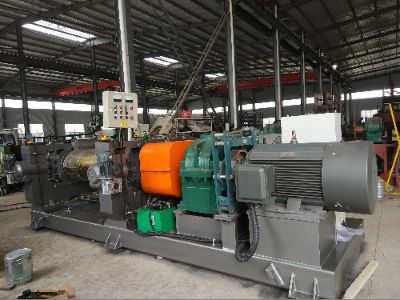
Consistency starts with knowing your machine's thermal lag. On most compact mills, the barrel and roll temperature readings on the display can drift five to seven degrees from the actual metal surface once material is flowing. Before locking in a recipe, run a short purge batch and shoot the roll faces with a handheld IR gun at three points—feed, center, and discharge. Record those offsets. If your controller says 170°F but the center reads 164°F, that six-degree gap needs to be baked into every subsequent setpoint, or your first ten pounds will always run stiffer than the last ten.
Roll speed is rarely about absolute RPM; it's about the shear rate at the nip and the dwell time in the gap. For repeatable batches, avoid chasing a single magic number. Instead, map speed against temperature in pairs: a slower roll with lower temperature can often match the dispersion quality of a faster, hotter setup, but the former will build less residual stress. Run a small design of experiments with three speed/temperature combinations, pull samples at the same elapsed time, and check both viscosity and surface gloss. Pick the pairing that holds the narrowest range across three consecutive batches—not the one that looks best on the first run.
Finally, document the warm-up and cool-down sequence, not just the steady-state settings. Many batch-to-batch drifts come from operators letting the mill idle at different temperatures or speeding up the rolls too early. A simple log—time to reach setpoint, time held at temperature before feed, and ramp rate of the rolls—will expose hidden variables. Once you control those transitions, the same speed and temperature inputs will actually produce the same output.
The Role of Nip Gap Geometry in Compound Uniformity
The nip region between two counter-rotating rolls is far from a simple slot. Its geometry—shaped by roll diameters, gap width, and the entry angle of the feed bank—dictates how intensively the material is worked. A narrower gap forces the batch through a thinner, longer shear zone, ramping up local shear rates and elongational stresses. The result is faster breakdown of agglomerates and more thorough distributive mixing. But a gap that is too small also drives up melt temperature and can cause over-mastication, degrading polymer chains and scorching heat-sensitive additives.
Subtle changes in nip contour matter as much as the gap dimension itself. Roll crowning, asymmetric offsets, or even a slight taper in the gap profile alter the residence time distribution across the roll face. Material at the edges may slip through with less work if the nip is wider there, leading to streaks of undispersed filler or uncured curatives. Conversely, a carefully profiled nip can redirect flow back toward the center, evening out shear history and producing a compound with consistent viscosity, dispersion, and cure behavior from batch to batch.
Practical mill and calender setups often exploit nip geometry deliberately. A slightly converging gap along the roll axis can compensate for roll bending under load, flattening the effective clearance and reducing edge-to-center non-uniformity. Meanwhile, feed guides or adjustable dams fine-tune the bank shape entering the nip, controlling how much fresh material folds into the rolling bank and how much passes directly through. These geometric adjustments, though small, are what separate a uniform, well-masticated compound from one riddled with hard spots and variable flow characteristics.
Handling Fillers and Oils Without Losing Dispersion Quality
Maintaining dispersion quality when adding fillers and oils often comes down to how those ingredients are introduced. Rather than dumping everything into the mixer at once, a staged approach works better: start with the base liquid, bring it to the target viscosity, then add fillers slowly while the mixer is running at a moderate speed. This prevents clumps from forming early and gives each particle a chance to wet out before the next batch is added.
Oils require a different tactic. If they are poured in too quickly or at the wrong temperature, they can coat the filler surfaces before the filler has fully dispersed, trapping air and creating a gritty texture. Preheating the oil to match the batch temperature and injecting it as a fine stream under high shear keeps the oil from pooling. In many cases, alternating small additions of filler and oil works better than adding all of one phase before the other, because it maintains a consistent viscosity window that lets the mixer blades do their job.
High-shear mixing alone is not always enough if the blade design is wrong for the batch size. A sawtooth blade or rotor-stator setup can handle dense fillers without bogging down, but it needs to be paired with vacuum degassing to remove air introduced by the oils. Monitoring torque rather than time gives a clearer signal that the filler is fully dispersed; when torque stops rising and levels off, the batch is usually ready for the next stage.
Spotting Inconsistencies Before They Reach the Curing Stage
The window between mixing and curing is where small deviations tend to hide. A slight change in resin viscosity, a shift in catalyst ratio, or uneven distribution of fillers can pass unnoticed if checks only happen after the batch has already set. By training operators to sample consistency at the dispensing point and comparing those readings with reference values from previous good runs, many problems become visible before the material ever enters the curing oven.
Visual cues often give the earliest warning. Streaks in a coating, tiny bubbles that don't dissipate, or a subtle change in surface gloss can indicate moisture pickup, poor degassing, or a miscalibrated mixer. Simple tools like a flow cup, a drawdown card, or a handheld viscometer can turn those impressions into measurable data. When recorded next to batch number and ambient conditions, these measurements form a pattern that reveals whether the inconsistency is random or tied to a particular shift, supplier lot, or equipment setting.
The goal isn't just to catch bad material; it's to adjust before cure locks in the defect. A batch that looks marginal can sometimes be corrected by re-mixing, adding a measured amount of solvent or hardener, or holding the material at a different temperature for a short period. Since cured material can't be reworked without grinding or scrapping, the cost of a 15-minute pause before the curing stage is usually far lower than dealing with a full batch of out-of-spec product later.
Keeping One Mill Running Multiple Formulations Safely
Running multiple formulations through a single mill demands more than just a good cleaning crew. The real hazard is invisible carryover: a trace of one recipe's additive or allergen ending up in the next batch. Many plants solve this by grouping formulations into compatible families and sequencing production so that a heavier clean happens only between riskier transitions. Color-coded hoses, dedicated scoops, and clearly marked bins cut down on the kind of mix-ups that walk in on two legs.
Documentation is the unsung hero here. Operators need batch records that show exactly which recipe is loaded, what the target set points are, and when the last washout was signed off. A simple visual board at the mill with the current formulation name, lot number, and next changeover time prevents someone from assuming the previous run is still in the hopper. Lockout points on ingredient inlets also help, so a line cannot be fed while another formula is draining.
Finally, small engineering tweaks often beat grand automation projects. A second screen set or a spare magnet drawer can be swapped in during changeover without waiting for a full teardown. If the mill feeds multiple downstream bins, verify the correct diverter position before starting—many contamination events come from a valve left in the wrong spot. These checks are cheap, fast, and they keep a flexible mill from becoming a liability.
FAQ
Standard mills are built for general-purpose use with fixed roll sizes, ratios, and clearances. A custom solution starts with your specific compound viscosity, filler loading, and required dispersion quality. The roll speed ratio, cooling passages, bearing arrangement, and even the surface finish of the rolls can be adjusted to match the way your material actually behaves. This reduces heat history, prevents scorching, and gives you a repeatable batch every time.
Roll size is driven by your batch volume, but configuration goes deeper than that. You need to think about the friction ratio. Too high can shear sensitive polymers, too low won't develop enough dispersion. Clearance adjustment range, roll deflection under load, and whether you need a hydraulic nip gap or manual adjustment all affect control. We usually start with a trial compound sample and work backwards to specify the geometry.
Yes, that's often the main reason people move away from off-the-shelf machines. For highly filled systems, you can specify hardened roll surfaces, replaceable liners, stronger drive motors, and more robust bearing seals. Abrasive fillers like silica or carbon black create a lapping effect, so roll material selection and surface treatment become critical to holding nip settings over time.
At minimum you need a rapid-stop cable or bar within easy reach on both sides of the mill, braking that stops the rolls within a quarter turn or less, and proper nip guards. But for precision work, also consider a roll temperature interlock that prevents operation until the cooling system is stable, and a load-sensing system that can detect a sudden increase in torque and stop before damaging the rolls or gearbox.
It's one of the most overlooked variables. If roll surface temperature drifts during a batch, the viscosity of the compound changes, which shifts the shear forces and affects dispersion. A precision mill uses drilled rolls with separate temperature zones and a closed-loop chiller or heater. This keeps the thermal profile steady, so you get the same level of work input from start to finish.
You need to check roll parallelism and bearing clearance on a regular schedule, not just when a batch goes wrong. Lubrication of the roll journals, alignment of the drive coupling, and calibration of the nip gap indicator should be part of a weekly routine. If you have a hydraulic gap adjustment, keep the fluid clean and monitor for internal leakage, because even a small drift in position will show up in compound consistency.
Retrofitting often makes sense if the frame and rolls are still in good shape. You can add automated nip control, replace the temperature control unit, upgrade the motor and drive to a VFD, and install load cells to monitor roll separating force. A full rebuild with new rolls and bearings can bring an older mill closer to modern tolerance levels at a fraction of the cost.
Share your full compound formulation or at least the base polymer and filler loading, typical batch weight, desired production rate per hour, and any processing temperature limits. Also mention if you run multiple recipes on the same machine. That helps define the working clearance range, cooling capacity, motor size, and whether you need features like variable friction ratio or automated gap adjustment.
Conclusion
A precision compounding line starts long before the first batch hits the rolls. Custom mills are built around the specific shear, cooling, and clearance demands of the compounds you actually run, not a generic catalog spec. Frame stiffness, roll crown, and drive sizing get matched to peak viscosity and filler loading so the machine doesn't flex or bog down mid-mix. Roll speed ratios are then tuned to balance dispersive and distributive mixing; a slightly wider friction ratio can break down hard agglomerates, while tighter speed control keeps heat-sensitive polymers from scorching. Temperature loops on each roll hold surface conditions within a few degrees, because even small drift changes how the bank turns over and how consistently the nip feeds. The nip gap itself becomes a process variable rather than a fixed setting. With adjustable gap geometry and wear-resistant roll faces, operators can hold the same working clearance across long runs, preventing the slow widening that quietly degrades compound uniformity.
Fillers and oils present the next challenge. Adding them too fast or at the wrong temperature collapses the rolling bank and traps undispersed clumps. Custom mill layouts often include sequenced feed ports, variable roll cooling zones, and automated oil injection timed to the batch's torque curve, so plasticizer uptake happens without losing dispersion quality. Process monitoring catches small inconsistencies early: torque spikes, bank temperature shifts, or odd sounds from the nip are tied to alarms rather than left to operator judgment. That means suspect batches get flagged before curing, where the cost of a bad mix multiplies. When one mill runs multiple formulations, changeover safety depends on more than cleaning. Dedicated or quick-release guides, separate oil/filler feed lines, and stored recipe parameters let the same hardware switch from a high-durometer mineral-filled stock to a soft carbon-black masterbatch without cross-contamination or guesswork.
Contact Us
Contact Person: Chen Zhengwei
Email: [email protected]
Tel/WhatsApp: +86-13963975727
Website: https://www.sfcrubbermachine.com