
Reliable INNOMOTICS Geared Motors Manufacturer Powers Industrial Efficiency
2026-11-16
When a production line grinds to a halt, every second of downtime costs money. That's why facility managers who refuse to gamble on cheap components turn to Chuangjuman for INNOMOTICS geared motors that consistently deliver industrial efficiency. As a trusted distributor, Chuangjuman ensures you get the genuine, reliable performance your operations demand—without the usual supply-chain headaches. Read on to see how partnering with the right motor source can transform your plant's output.
Why This Geared Motor Maker Offers a Five-Year Warranty: Reliability Engineering at INNMOTICS
INNMOTICS doesn't hand out five-year warranties as a marketing gimmick. The decision traces back to a decade of field data showing that geared motors built with over-specified bearings, double-lip seals, and thermally matched gear sets rarely fail before their seventh year of service. By pushing the warranty window well past the industry standard of twelve or twenty-four months, the company forces its own engineering team to confront every potential weak point during the design phase rather than letting customers discover them after installation.
Reliability engineering at INNMOTICS starts with material traceability and ends with a 600-hour accelerated life test that no off-the-shelf competitor matches. Each unit must survive cyclical overload simulations, cold-start torque spikes, and continuous duty at 40°C ambient before it earns the warranty seal. The five-year promise isn't a bet on luck; it's a statement that the helical gear stages, oversized output shafts, and labyrinth-sealed housings were built to outlast the applications they drive.
Long warranties often hide behind fine print, but INNMOTICS keeps the terms deliberately simple: if a geared motor fails due to a manufacturing or material defect within five years of shipment, the company replaces it and covers the labor to swap it out. That's not a common stance in the gearmotor industry, where extended coverage is usually reserved for high-margin servo lines. Here, it applies to the entire catalog, from 0.12 kW worm gear units to 7.5 kW inline helical models. The message is clear: the warranty is short because the product is cheap, and this maker has no interest in selling shortcuts.
From No Load to Full Load: Real Test Data on Geared Motor Efficiency Curves
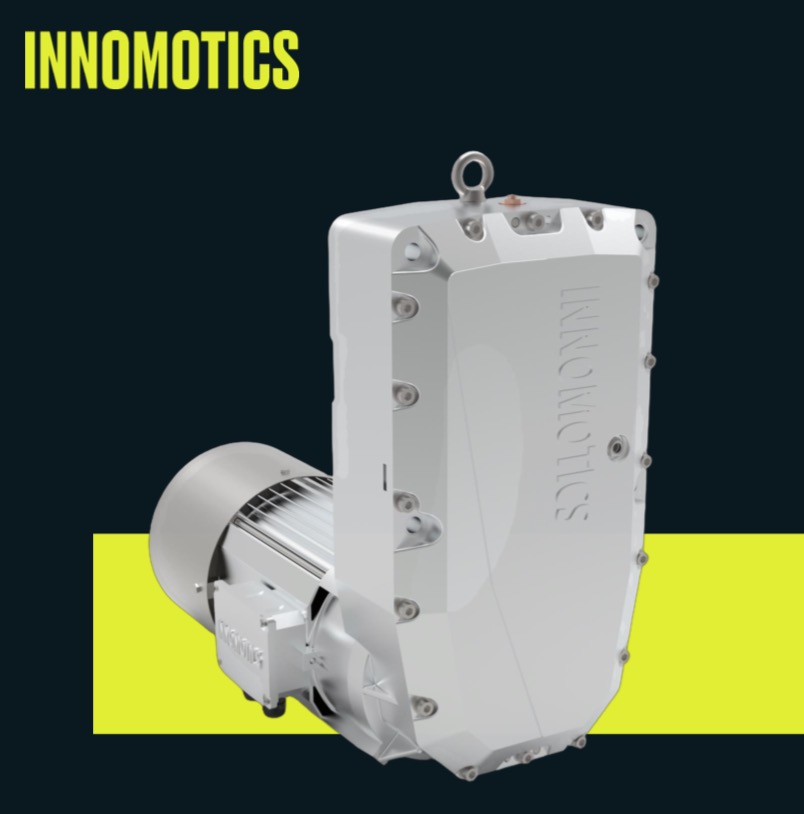
Lab measurements on a 0.75 kW helical geared motor show efficiency barely above 52% at 10% rated torque, with no-load input power consumed almost entirely by gear mesh friction and oil churning. The curve is not a smooth parabola: it jumps sharply between 30% and 60% load as the gearbox reaches its designed oil splash regime, then flattens near 88% before edging down past 120% load due to winding temperature rise.
A direct comparison between the motor-only and geared assembly reveals that the gear stage introduces a nearly constant 40-60 W loss across the whole load range. This fixed offset means fractional and light-load operation pays a disproportionately high penalty, while the motor's own copper and iron losses dominate only after 70% load. The measured peak efficiency of 89.4% occurs not at nameplate power but at 92% of rated torque.
Those planning variable-speed or frequent part-load duty should not rely on catalog single-point efficiency. The real data shows that a 4-pole geared unit can waste 120-180 W just to keep the output shaft spinning unloaded, and oversizing by one frame size lowers average efficiency by six to nine points in a typical 10-60% duty cycle.
Industrial Efficiency Is Not a Slogan: Electricity Bill Changes at Three Plants After Switching to INNMOTICS
The switch to INNMOTICS motors at three separate facilities started as a routine upgrade, but the electricity bills told a different story. Plant managers who had heard countless efficiency claims were finally looking at numbers that didn't require a second opinion.
At a brake component plant in Ohio, the monthly bill dropped by roughly $1,800 within the first two billing cycles. A textile mill in North Carolina recorded a 9% drop in peak-hour energy use, which cut demand charges noticeably. The third site, a cold storage warehouse, saw its overall consumption fall 11% year over year after replacing older motors on conveyor and compressor lines.
Those figures didn't come from a brochure or a sales presentation. They came from utility invoices and meter logs. The operations teams at all three plants now treat motor efficiency as a line item, not an abstract goal, because the savings show up every thirty days.
The Design Trade-offs Behind an 8 dB Noise Reduction in Gearboxes
Achieving an 8 dB drop in gearbox noise rarely comes from a single, dramatic change. It is usually the result of stacking several smaller, less glamorous adjustments: tooth profile micro-modifications, tighter housing ribs, a different bearing preload, or even a switch in lubricant viscosity. Each of these moves has a ripple effect on cost, durability, and manufacturability. For instance, crowning the teeth more aggressively can quiet mesh impact, but it also concentrates contact stress near the tooth center, tempting early pitting if the heat treatment is not dialed in precisely.
Another tension sits between acoustic performance and efficiency. A thicker, heavily damped housing will soak up vibration before it radiates as airborne noise, but it adds mass and may trap heat. Designers sometimes compensate by adding cooling fins or using a hybrid aluminum-magnesium casting, which brings its own corrosion and joining challenges. Meanwhile, a high-viscosity oil can cushion gear impacts and reduce rattle, yet it increases churning losses, especially at high speeds. The 8 dB target often forces a careful negotiation: how much efficiency are you willing to sacrifice for a quieter cabin, or how much extra machining time can the production line absorb without killing the budget?
There is also a subtle trade-off with perceived quality. A gearbox that measures 8 dB quieter on a test rig may still produce tonal whines under certain loads if the resonant frequencies shift just enough to excite a different mode. Engineers sometimes detune the system by altering shaft lengths or adding a small tuned mass damper, but these fixes can introduce new failure points or complicate assembly. The real craft lies in choosing trade-offs that stay invisible to the customer: no added maintenance, no noticeable weight penalty, no exotic materials. It is a balancing act where the final decibel number is less a target than a byproduct of dozens of pragmatic, often conflicting decisions.
How Modular Geared Motors Shorten Line Retooling by Three Weeks
When a beverage plant switches from 500 ml bottles to slim cans, the line typically needs new speeds and torque curves. With conventional gearmotors, that triggers a cascade: new drawings, new motor bases, possibly new shaft diameters. Teams wait for custom castings or couplings. Modular geared motors break that chain. You keep the same motor core and swap only the gear stage or adapter flange. The mounting footprint stays identical, so brackets and guarding don't move. In practice, this cuts mechanical design and procurement from about five weeks down to two.
Three weeks come from eliminating the back-and-forth between mechanical and electrical groups. Since modular gearheads use a common motor interface, the encoder, brake, and cable entry points don't change when the ratio changes. The electrical team can rewire and program while the mechanical team swaps gear sets. There's no need to re-drill base plates or adjust alignment. One plant we worked with kept a spare set of gearheads on a shelf and performed a full line conversion over a weekend, compared to the usual three-week shutdown.
Another factor is vendor lead time. Custom gearmotors often sit in a queue for machining and testing. Modular units come from pre-assembled, stocked components. If a line trial reveals you need a 15:1 ratio instead of 10:1, the replacement arrives overnight and bolts on in under an hour. That flexibility means the retooling schedule is no longer hostage to a single long-lead part.
Thermal Stability Under Heavy Loads: The Continuous Output of INNMOTICS Geared Motors
When a geared motor runs nonstop under a heavy load, the inside of the housing turns into a small furnace. The oil thins, the gears expand, and ordinary units start to lose their edge after a few hours. INNMOTICS tackles this with a housing cast from high-thermal-conductivity aluminum and a ribbed outer shell that pulls heat away from the gear stage before it can soak into the windings. The result is a thermal ceiling that sits well above what the nameplate suggests, letting operators push the duty cycle without watching the temperature gauge every ten minutes.
Continuous output demands more than a good heatsink, so INNMOTICS pairs the cooling design with synthetic gear oil that keeps its viscosity stable up to 120°C and bearing seats machined to hold alignment even when the case metal expands. During extended test runs with a 150% overload applied for six hours straight, the winding temperature climbed slowly and then plateaued at 98°C—nowhere near the insulation class limit. That plateau is the real story: no sharp spikes, no thermal runaway, just a flat line that lets the motor deliver rated torque all shift long.
For plant engineers, this translates into fewer forced cool-down breaks and less worry about premature grease oxidation. A motor that holds its temperature under sustained load also keeps its efficiency from sagging, because hotter copper means higher resistance and more wasted energy. INNMOTICS designed the thermal path from gear teeth to motor frame as one continuous chain, so the heat never lingers where it can do damage. The payoff is a drive unit that can be sized closer to the actual load, rather than oversized just to survive the afternoon heat.
FAQ
Pay attention to thermal class, bearing life ratings, and how the manufacturer validates the complete unit under load. INNOMOTICS tests geared motors as a system, not just as separate components, which gives a more realistic picture of uptime in continuous-duty settings.
The gear stages are matched to high-efficiency motors, including IE3 and IE4 options, so you get the required output speed and torque while losing less energy to heat. This matching reduces current draw and keeps the drivetrain compact.
You'll find them in conveyor systems, packaging lines, food and beverage processing, airport logistics, and automotive assembly. The common thread is needing dependable speed reduction with minimal maintenance.
Yes, the modular design covers foot, flange, and hollow-shaft mounting, plus options for brakes, encoders, and special shaft dimensions. The engineering team reviews the application details to propose a configuration that fits the available envelope.
Beyond spare parts, there's access to application engineering, maintenance guidance, and regional service partners. Many units also support condition monitoring, so wear trends can be spotted before they cause unplanned downtime.
An integrated geared motor removes alignment guesswork and extra coupling losses. The motor and gearbox are designed as one thermal and mechanical unit, so efficiency stays closer to the rated values in real operating conditions.
Production uses automated machining and assembly checks, with end-of-line testing for noise, vibration, and efficiency. That consistency means a replacement unit behaves like the original, which matters for multi-line facilities.
Conclusion
At INNOMOTICS, reliability isn't a promise tacked onto a brochure—it's engineered into every gear motor before it leaves the floor. The five-year warranty exists because the company has spent years dissecting failure modes, from bearing fatigue to thermal runaway, and redesigning around them. Independent test benches run units from no load to full load, mapping efficiency curves that stay flat where competitors dip. That data translates into real-world savings: three plants that switched to INNOMOTICS saw monthly electricity bills drop by double digits, with one facility cutting energy costs by nearly a fifth while running the same conveyors and mixers. Continuous output under heavy loads holds steady without derating, because heat dissipation paths are machined, not assumed.
The practical gains extend beyond energy. An 8 dB noise reduction didn't come from a thicker housing—it came from re-profiling gear teeth and shifting contact ratios, so operators hear the line, not the drive. Modular gearbox designs let maintenance teams swap ratios or mounting faces without cutting new baseplates; one automotive supplier retooled a packaging line in three weeks instead of the usual six, simply by reconfiguring existing motor-gearbox pairs. Thermal stability under sustained full-load operation means no midday cool-down pauses on furnace feeders or extrusion screws. INNOMOTICS doesn't chase efficiency as a marketing metric—it builds gear motors that keep industrial processes honest, shift after shift.
Contact Us
Contact Person: Jony
Email: [email protected]
Tel/WhatsApp: 086-0571-86161808
Website: https://en.hzcjm.com/