
Top Power Line Inspection Drone Simulator: Realistic Training for Utility Drone Pilots
2026-08-31
Realistic training for utility drone pilots shouldn't be a luxury—it's a survival skill. Power line inspection leaves zero margin for error, yet most simulators still offer cartoon physics and forgiving crash mechanics. SRIZFLY flips that script with a top-tier power line inspection drone simulator that recreates the wire-strike risks, electromagnetic interference, and split-second decision-making of the real job. If you've been waiting for a training platform that respects the stakes, this is it.
Realistic Wind and Magnetic Interference: What Your Current Training Is Missing
Most simulator drills treat wind as a steady push from one direction. Real gusts arrive in ragged pulses, shift without warning, and get funneled between buildings or tree lines. If your practice sessions don't force you to correct for sudden yaw drift and throttle surges, you're memorizing stick movements instead of learning how the aircraft actually responds.
Magnetic interference is worse because it rarely shows up in clean test environments. Power lines, rebar in concrete, metal roofs, and even your phone can bend the compass enough to make the flight controller misread heading. When that happens mid-mission, the aircraft may fight your inputs or drift sideways during hover. Training should include deliberate compass degradation drills, not just a warning pop-up on a screen.
From Simulator Hours to Real-World Confidence on Transmission Towers
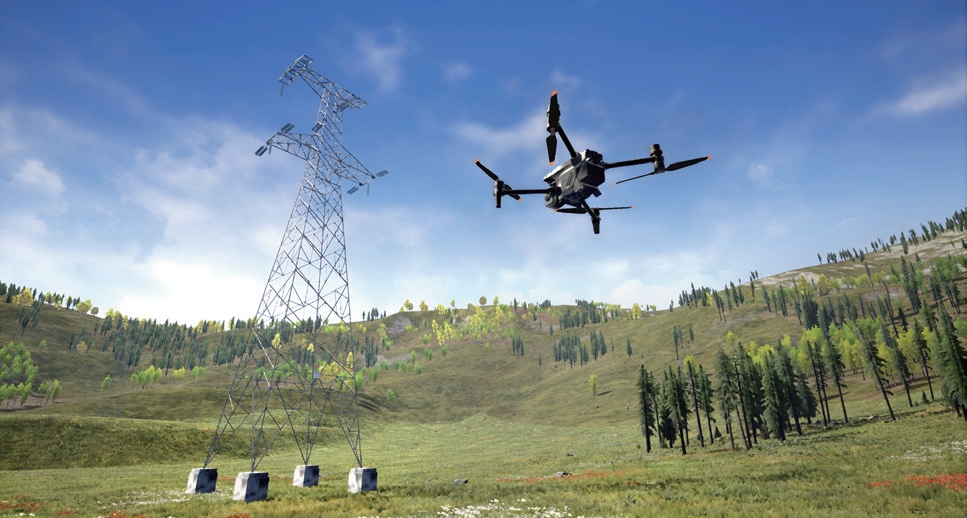
Working on transmission towers has never been something to take lightly. Yet simulator training has completely reshaped how workers prepare for the climb. Through countless hours of virtual ascents and operations, newcomers can make mistakes and learn from them without the weight of real-world consequences. This repetitive practice doesn't just sharpen technical skills—it builds a mental resilience that proves invaluable the moment you step onto an actual structure.
The shift from simulator to real tower still feels intimidating, but those who put in the hours find their muscle memory takes over. The click of a safety harness, the texture of metal under gloves, the wind hitting your face—these sensory details can overwhelm during a first real climb. However, simulator training instills a procedural knowledge that lets workers focus on adapting to the environment instead of second-guessing every movement.
Ultimately, the time spent on simulators translates directly into real-world operational confidence. Workers report feeling far more composed after repeatedly encountering problem scenarios in simulation. That sense of "I've seen this before" bridges the gap between virtual and physical, making the transition from training to execution feel less like a leap and more like a natural progression.
The Hidden Physics Most Power Line Drone Simulators Get Wrong
Most power line inspection drone simulators treat the wires as static obstacles and throw in a bit of uniform wind to make things feel realistic. But near a live high-voltage line, the dominant force isn't just wind—it's the oscillating electromagnetic field. An AC line at 50 or 60 Hz generates a magnetic field strong enough to induce eddy currents in the drone's carbon fiber or aluminum frame, which in turn distorts the onboard magnetometer. The result is a yaw reading that can drift several degrees within seconds, causing the flight controller to make small, uncorrected heading changes that no standard simulator reproduces. Worse, these errors aren't linear; they spike when the drone's orientation aligns with the field lines, so an operator trained on a clean virtual model gets a false sense of stability.
A second overlooked factor is the aerodynamic wake off the conductors themselves. Overhead power lines aren't smooth cylinders; they're stranded, often with accumulated dirt or ice, and they shed turbulent vortices at the drone's typical inspection distance. These vortices create localized gusts and downwash that can flip a lightweight quadcopter if it hovers too close downwind. Add to that the ion wind from corona discharge on high-voltage hardware, which subtly changes air density and can produce unpredictable lift changes right where the drone needs to position for a close-up shot. Most simulators either ignore corona entirely or model it as a visual spark, missing the physical push it gives the air.
Finally, there's the thermal plume rising from sun-heated conductors and insulators, which interacts with the electromagnetic and aerodynamic effects in ways that are chaotic but measurable. A drone that is stable in a simulation might encounter a sudden pitch-up when crossing from the shaded side of a line to the sunlit side, or a compass error that only appears when the gimbal is angled a particular way. Until simulators couple electromagnetic field solvers with high-fidelity micro-turbulence models, pilots will keep discovering these hidden physics the hard way—during a live inspection at 30 meters.
Emergency Procedures Near Live Lines: Practice Without the Risk
Working near energized conductors demands more than theoretical knowledge; it calls for muscle memory that only repetition can build. Yet the stakes leave no room for trial and error on the real grid. That's why modern training programs use immersive simulations, staged live-line yards, and virtual reality scenarios that replicate exact voltage gradients, arc flash boundaries, and insulator leakage currents. Trainees can make mistakes, see the consequences rendered in real time, and reset instantly to try again—turning catastrophic misjudgments into durable lessons without a single spark touching human skin.
A typical drill might place a crew at a de-energized structure fitted with induced voltage sources and proximity alarms. The instructor triggers hidden faults: a sudden wind gust swings a conductor closer than the minimum approach distance, a tool touches a grounded member while the line is momentarily back-fed, or a worker loses footing on a pole with one hand reaching out. Every response is logged, then debriefed against slow-motion footage captured from multiple angles. Because the hazard is simulated but the physiology is real—heart rate spikes, tunnel vision, the urge to grab rather than fall away—crews learn to override instinct with procedure. After twenty repetitions, the correct bailout, the right communication callout, and the habit of testing for absence of voltage become second nature.
For utility companies, this kind of practice without risk also slashes training downtime and insurance exposure. Instead of reserving a rare de-energized window on a critical feeder, a crew can rehearse the same emergency response every month in a controlled environment. The data from each session feeds into a personal proficiency score, flagging workers who need extra coaching on specific maneuvers—say, rescue from a bucket truck or applying a temporary protective ground under time pressure. What emerges is a workforce that doesn't just know the rulebook; they've already lived through a dozen near misses and walked away ready to make the right call when the line is truly live.
How Scenario Variety Prevents Costly Inspection Mistakes
Inspection errors rarely come from a single bad decision. More often they grow out of repetition—same lighting, same part orientation, same expected defects. A person checking identical assemblies for hours starts to see what they expect, not what is actually there. Flipping the script with varied scenarios, like switching between different batch origins, surface finishes, or test temperatures, pulls inspectors out of autopilot. Suddenly every unit gets a fresh look, because the context keeps changing just enough to demand active judgement.
Scenario variety also catches weaknesses in the inspection plan. A line that only runs smooth, clean samples will not reveal how inspectors react to contaminated parts or borderline measurements. Introduce a few deliberately tricky cases—a faint crack under uneven light, a label misaligned by half a millimetre, a batch with mixed suppliers—and the team quickly sees which criteria are too vague or too rigid. Those lessons prevent the expensive kind of mistake where a defect looks fine on paper but fails in the field.
Utility Drone Training That Mirrors the Job, Not Just the Controls
Most drone training programs lock you into memorizing stick movements and button sequences, but real utility work happens in messy, unpredictable environments. Inspecting a high-voltage line means reading sag and wear while fighting wind gusts; mapping a flooded substation requires adjusting flight paths around half-submerged equipment. Our training flips the order—you start with the actual task, then learn the controls needed to pull it off.
You won't spend hours hovering in an empty field. Instead, you'll practice thermal scans over live electrical panels, corridor mapping through dense vegetation, and payload drops onto narrow service platforms—all with the same telemetry feeds and safety checks field crews use daily. Each scenario includes realistic failures: a sudden GPS dropout, a shifting load, a radio dead zone. You learn to prioritize the mission, not just the maneuver.
By the end, the controller feels less like a gadget and more like an extension of your judgment. You'll have logged scenarios that mirror actual damage reports, outage tickets, and maintenance schedules—so your first day on a real utility site doesn't feel like a simulation. It feels like Tuesday.
FAQ
Unlike generic flight trainers, this platform recreates the exact visual and physical challenges of flying near high-voltage infrastructure—think conductor sag, insulator strings, and tower geometry—so pilots learn to manage the electromagnetic interference and tight clearances unique to utility work.
The scenarios are built from real-world LiDAR scans and maintenance records, which means pilots encounter authentic obstacles like overgrown vegetation under spans, corroded hardware, and uneven terrain. Even the way the drone responds to rotor wash near energized lines has been tuned to match field measurements.
It's designed with a gentle learning curve, so someone brand new to drones can start with basic hovering and camera control before moving into complex inspection routes. That said, experienced utility pilots will still find advanced modules on confined-space work and night operations challenging.
The training walks through all core inspection tasks: tower-top mapping, insulator string close-ups, conductor sag measurement, vegetation encroachment checks, and even post-storm damage assessment. Each mission includes realistic client reporting requirements, so pilots also practice documenting findings correctly.
You can dial in sudden crosswinds, GPS signal loss, battery voltage sag, or even a motor failure mid-flight. The physics engine then forces you to react with the same control inputs you'd use on a real job—no pause button, just like in the field.
Every flight is recorded with a full telemetry overlay, and the system flags deviations like approaching minimum clearance distances or excessive yaw oscillations. After each session, pilots get a breakdown of their energy management, camera framing, and flight path efficiency, which makes it easy to spot habits that need work.
A mid-range gaming PC with a dedicated graphics card and a controller that closely matches the sticks on a real utility inspection drone will give you the most transferable feel. Many teams also add a VR headset for depth perception practice when hovering close to conductors.
Yes, because the training modules align with typical utility aviation standards and include scenario-based check rides that mirror common certification tests. Companies can track pilot progress over time and use the built-in reports to document recurrent training hours without sending crews to a physical range.
Conclusion
Most utility drone training stops at teaching stick movements and camera angles, but real transmission tower inspections punish that narrow focus. A top-tier power line inspection simulator stands apart by modeling the invisible forces that shape every flight: shifting wind shear around tower legs, electromagnetic interference that degrades compass data and GPS signals, and the subtle aerodynamic quirks of a heavily loaded inspection drone. Pilots who practice in these conditions learn to read drift, anticipate signal dropouts, and keep safe distances without relying on guesswork. The result is confidence that carries directly to the field, whether you are hovering beside a 345 kV line or navigating between bundled conductors.
The simulator’s value goes deeper than basic physics. Emergency procedures near energized lines—like sudden motor failure, battery sag, or unexpected rotor wash—can be rehearsed repeatedly, building muscle memory that no classroom can match. Scenario variety matters just as much: from corroded insulators to vegetation encroachment and broken spacers, each mission forces you to adjust flight paths and inspection angles. This mirrors the actual job, where a single oversight can mean missed damage or a costly outage. Instead of teaching you to operate a controller, the right simulator trains you to think like a utility drone pilot, balancing safety, efficiency, and the unforgiving realities of live-line infrastructure.
Contact Us
Contact Person: Niles Liu
Email: [email protected]
Tel/WhatsApp: 8619945009803
Website: https://srizfly.com/